
Table of Contents
Southeast Asia is one of the fastest-growing technology markets in the world. It is also one of the worst for electronic waste. The region generates 12.3 million tonnes of e-waste every year. Less than 15% gets formally recycled. The rest gets dumped, burned, or shipped elsewhere.
At the same time, for a significant share of the population across the region, a premium laptop or smartphone costs more than a month’s salary. Traditional financing locks them out. Buy Now Pay Later comes with interest rates that make ownership feel like a trap.
These two problems — overconsumption at one end, underaccess at the other — look like opposites. They have the same root cause: a device economy built entirely around ownership.
Buy. Use. Discard. Repeat.
The circular economy offers a different path. And Device-as-a-Service (DaaS) is one of its most powerful expressions in consumer technology.
The Case for a Circular Device Economy in SEA
The subscription economy transformed how we consume music, film, and software. It never solved hardware — because no one retained ownership of devices long enough to keep them in circulation, refurbish them at scale, and redeploy them to the next user.
That gap is what a true circular device model closes. When a company retains ownership of a device across its full lifecycle — leasing it, collecting it, refurbishing it, and redeploying it — every additional rental cycle displaces the need to manufacture a new device. Every refurbishment event keeps hazardous materials out of landfill. Every subscriber who gains access through a flexible subscription rather than an outright purchase extends the productive life of that device while reducing upstream manufacturing demand.
This is not incremental sustainability. It is a structural alternative to the linear model that has defined consumer electronics for decades.
For a region generating millions of tonnes of e-waste annually, with formal recycling infrastructure that remains severely underdeveloped, the circular device economy is not a niche initiative. It is the infrastructure SEA needs to build.

Measuring What Actually Matters in Circular Business Models
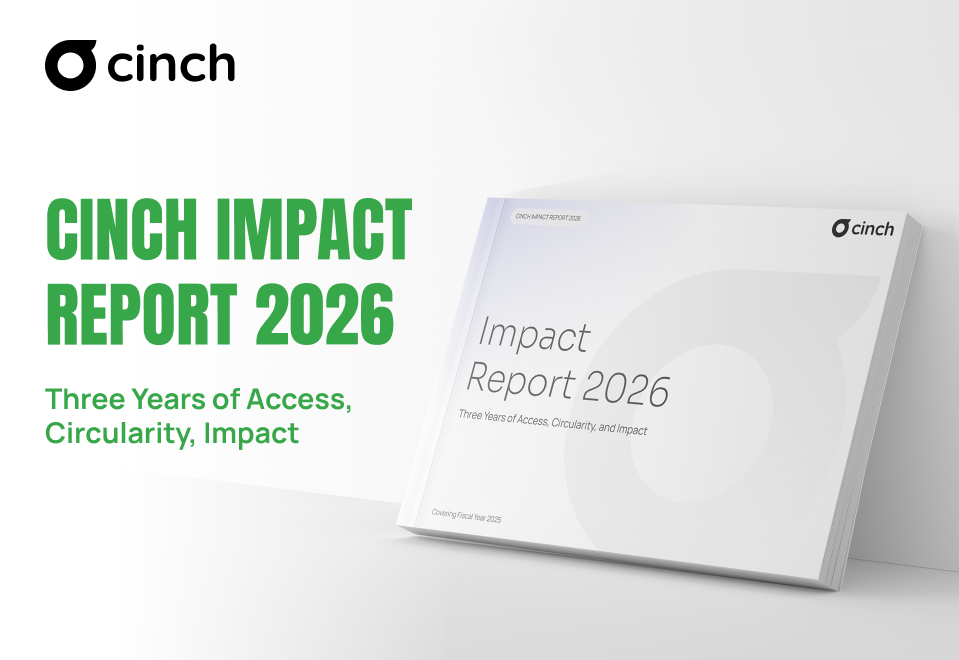
Three years ago, Cinch was founded on this thesis. Today, we have published our inaugural Impact Report — an attempt to measure whether a DaaS model delivers on its circular promise at scale. We expanded our measurement across four impact dimensions: device access, SME empowerment, emission reduction & e-waste reduction.
What Three Years of Circular Device Deployment Looks Like
The FY2025 numbers make the case across several impact pathways.
On circularity:
Refurbishment events grew 688% while turnaround time fell 46% in the same year — operational scale making the process simultaneously faster, cheaper, and lower-carbon. Total refurbishment carbon footprint was 5.4 tCO2e against 82.5 tCO2e of avoided manufacturing emissions: a 15:1 carbon return on investment.
Cinch net avoided emissions of 62.3 tCO2e is the residual after honest deductions for refurbishment, last-mile, and end-of-life — the verified figure, not the gross headline. Devices entering a second or later rental cycle — the core mechanism through which emissions are avoided — grew 510% year-on-year, with over one million devices now targeted for annual circulation by 2030.
On access:
Cinch saw a 318% year-on-year increase in approved applicants. Of those, 22.4% went to customers with no other channel available — genuine first-time access, not displacement of existing fintech. A further 31.4% would have delayed access without Cinch. Combined, that is meaningful access uplift for more than half the customer base.
On business empowerment:
SMEs account for approximately 65% of employment across SEA, yet hardware CapEx remains one of the most stubborn constraints on their growth. Cinch converts that CapEx into flexible OpEx — and the FY2025 numbers show the model gaining traction fast.
B2B client retention grew 44% YoY. Devices under management grew 189%. Working capital unlocked grew 152% — capital that flows to hiring, inventory, and customer acquisition rather than depreciating laptops. The 2030 target of SGD 327M unlocked annually is the scale at which this becomes a meaningful input to SME growth across the region.

What a Mature Circular Device Economy Looks Like by 2030
By 2030, Cinch aims to have one million devices in annual circulation across Southeast Asia — a scale at which a 50% recirculation rate yields 62,375+ tCO₂e in gross avoided emissions and over 100 tonnes of e-waste diverted per year.
Getting there requires three things: better data, deeper product circularity, and geographic scale. On data, the path runs from secondary OEM benchmarks today to primary lifecycle assessments and third-party emissions assurance by 2030. On geography, Singapore proves the model. Southeast Asia scales it.
The circular device economy is not a compliance aspiration. It is the next infrastructure layer for a region that cannot afford to keep discarding its technology.
Cinch Impact Report 2026
Keen to get a detailed insight into our findings? Check out our Impact Report in the link below: