
Table of Contents
Open a drawer in almost any Singapore home and you will probably find it: a phone that still turns on, still holds a charge, still works — just sitting there. Not broken. Not donated. Not recycled. Just waiting for a decision that never quite gets made.
Across Singapore, an estimated 2.9 million smartphones are doing exactly that right now.
That number comes from Cinch’s own research into device habits across the city-state, published in our Impact Report 2026. It sits at the centre of a problem we spend a lot of time thinking about. It is not a recycling problem. It is a structural problem — and the two are not the same thing.
This post is about what that idle pile really costs, why the usual fixes have not worked, and what a fundamentally different model of accessing devices does to the numbers.
Tackling Singapore’s E-Waste Problem
Singapore generates around 60,000 tonnes of e-waste every year — roughly equivalent to every resident discarding 70 mobile phones annually. The government has invested significantly in collection infrastructure: there are now over 1,000 e-waste collection points islandwide. And yet formal collection has historically captured only a fraction of what actually gets discarded.
That gap is not primarily an infrastructure problem. Singapore has more e-waste collection points per square kilometre than almost any comparable city in the region. The gap exists because the model through which most people access devices in the first place creates no natural incentive to return them. The transaction is complete the moment you buy. What happens after that is entirely up to you.
Southeast Asia as a whole generates 12.3 million tonnes of e-waste annually. Less than 15% is formally recycled — compared to over 40% in the EU. The difference is not just bins and regulations. It is whether the economic model of device access keeps hardware in productive circulation, or lets it drift into drawers and landfills.

Why Phones End Up in Drawers Instead of Being Recycled
Singaporeans replace their smartphones on average every 2.7 years — considerably faster than the global average of 3.5 years. This is not surprising in a tech-forward city with competitive telco upgrade cycles and a culture that moves quickly on new products.
The problem is what happens to the old device. Most are not recycled. Most are not traded in. Most are not sold. They are put somewhere safe with a vague intention to deal with them later. That intention rarely becomes action.
There are structural reasons for this. Trading in to a telco typically nets very little unless you are upgrading with them simultaneously. Selling on Carousell requires time, effort, and trust. Dropping a functional phone into an e-waste recycling bin feels like giving up something that still has value — even if you are not extracting that value yourself. So the phone stays in the drawer. And across 2.9 million households, the problem compounds.
This is what Singapore’s e-waste challenge actually looks like in practice. Not a single dramatic disposal event, but millions of small non-decisions, each one leaving a device in limbo rather than in use or properly processed.
The Real Environmental Cost of an Idle Device
When most people think about e-waste in Singapore, they picture the end — devices going into bins, or worse, into landfills. But the environmental cost of electronics is front-loaded, not back-loaded.
Every smartphone manufactured requires the extraction of dozens of materials — lithium, cobalt, gold, rare earth elements — many from mining operations with serious environmental and human rights footprints. The carbon and resource cost is paid at the point of manufacturing. When a device sits in a drawer unused, that cost has already been incurred. The useful life the device could have delivered has simply been forfeited.
Each refurbished smartphone, according to published lifecycle assessment data, avoids approximately 25 kg of CO2 emissions, 77 kg of raw material extraction, and 56 grams of electronic waste compared to manufacturing a new unit. The most effective form of e-waste reduction is not recycling the old device — it is keeping it in use long enough that no new device needs to be made to replace it.
That is a fundamentally different framing from how most e-waste conversations in Singapore are structured. The recycling bin is not the solution. Extended device life is.
Why the Ownership Model is the Root Cause
When you buy a phone outright, you own it. But ownership also means you absorb the depreciation, you are responsible for disposal, and there is no system that pulls the device back into productive use when you are done with it.The loop is open.
This is the structural problem underneath Singapore’s e-waste numbers. Standard device purchasing creates a one-way flow: manufacture, sell, use, discard. E-waste is the downstream symptom of that flow. Adding collection points at the end helps at the margin, but it does not change the flow itself.
Fixing Singapore’s e-waste problem at scale requires keeping devices in active use for longer — through a model that retains accountability for the device across its full life, not just at the point of sale. That means the entity managing the device has a financial incentive to refurbish it, redeploy it, and extract maximum useful life from it before it exits the system entirely.
That is the economic logic behind circular device infrastructure.
What Closing the Loop Actually Looks Like in Practice
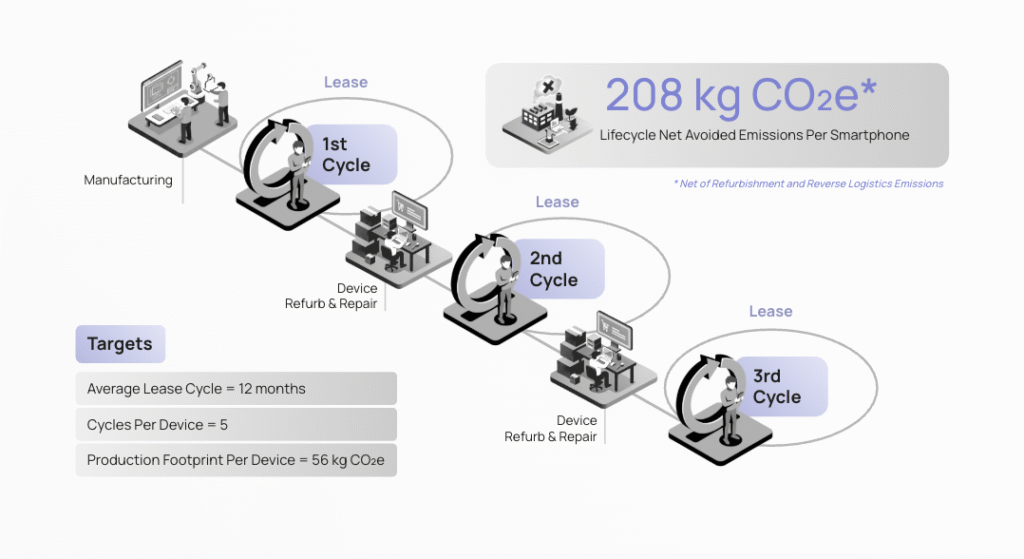
Cinch retains ownership of every device on our platform. When a subscription ends, the device comes back, goes through our refurbishment process — tested, cleaned, repaired where needed — and re-enters circulation for the next user.
In FY2025, second-plus cycle subscriptions on our platform grew 510% year-on-year. Refurbishment events grew 688%. Refurbishment turnaround time fell 46%.
The carbon footprint of our entire refurbishment operation in FY2025 was 5.4 tCO2e.
We are transparent about the methodology behind these numbers — the full approach uses the Circular Business Model Impact (CBMI) framework and GHG Protocol, and is published in the Cinch Impact Report 2026. But the direction is unambiguous. Multi-cycle device circulation works, and the unit economics improve as the fleet matures.
By 2030, Cinch’s target is to divert over 100 tonnes of e-waste from landfill annually, with a 50% recirculation rate across one million devices in circulation.
Singapore’s E-Waste Gap Has an Access Dimension Too
There is a second dimension to the idle phone problem that gets less attention than the environmental one.
When a device circulates through multiple users via a subscription model, the cost of that device is distributed across its full useful life rather than loaded entirely onto the first buyer. This makes the second-cycle subscriber — often someone accessing a device category they could not previously afford — part of what makes the circular model financially viable.
In our most recent customer survey, 31% of Cinch users said that without a subscription model, they would have waited and saved to buy outright. 22% said they would not have had access to the device at all.
In a region where upfront capital constraints and thin credit files are the norm for many households and small businesses, that is not a marginal finding. It means the circular model is doing two things simultaneously: reducing e-waste in Singapore by extending device life, and widening access to technology for people the standard ownership model was not serving.
Total credit applications processed through Cinch grew 318% year-on-year in FY2025. Credit approval rates improved 22%.
Access and circularity are not in tension here. Each additional lease cycle reduces the effective cost per user. The most affordable way to put a capable device into someone’s hands is usually to use one that already exists.
What You Can Do With That Phone in Your Drawer
If you have an idle device at home, the most impactful thing you can do is not recycle it — it is get it back into use. That might mean selling it, trading it in, or returning it through a platform that will refurbish and redeploy it rather than strip it for parts.
If you are thinking about your next device upgrade, the question worth sitting with is whether ownership is actually the right model. Subscription-based access costs less upfront, includes protection, and — if the platform behind it runs a genuine circular operation — means your device will serve another user after you rather than becoming part of Singapore’s e-waste statistics.
The 2.9 million phones sitting idle in Singapore right now did not end up there because Singaporeans are careless. They ended up there because the system that delivered those phones created no good path back. Changing that is not a consumer behaviour problem. It is a model design problem — and circular device infrastructure is built to solve it.
Cinch Impact Report 2026
For the full methodology and data behind this piece, download the Cinch Impact Report 2026.